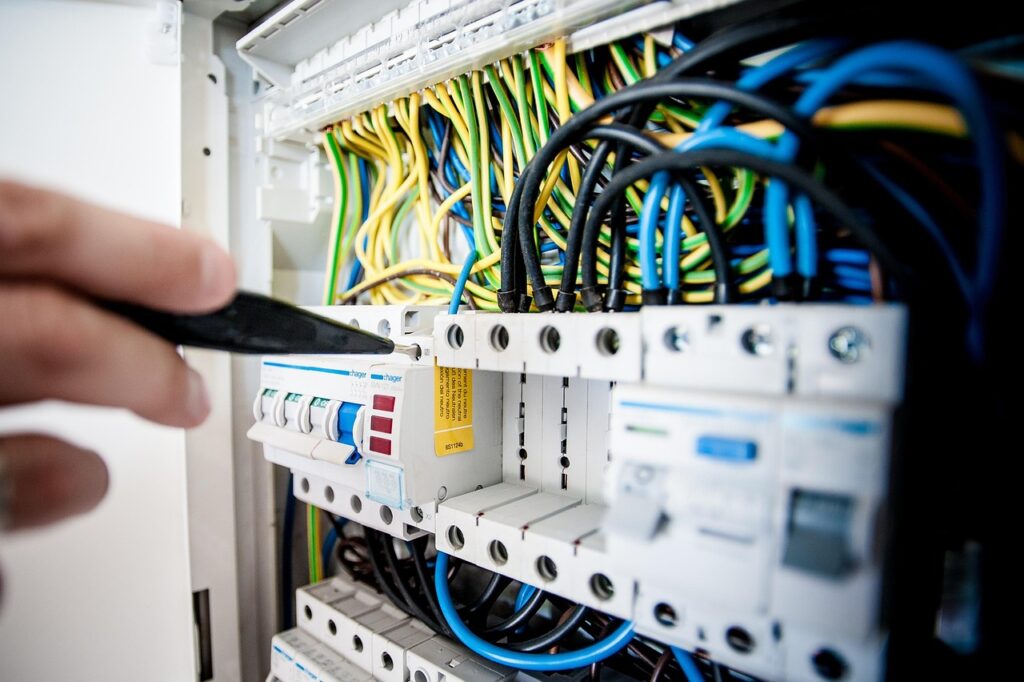
Preparing for your electrician license exam? Whether you’re working toward your journeyman certification or brushing up on the National Electrical Code (NEC), this free electrician practice test will help you get exam-ready. With real-world questions and automatic scoring, you’ll quickly find out where you stand—and what to study next.
What’s on the Electrician Exam?
Most state electrician licensing exams—like those used in California, Texas, Florida, and nationally through PSI/NCCER—cover core areas of electrical knowledge:
Electrical theory and calculations (Ohm’s Law, voltage, current, power)
National Electrical Code (NEC) layout, grounding, conductor sizing, and circuits
Conduit fill, ampacity, and load calculations
Safety protocols, PPE, and OSHA electrical standards
Service panels, transformers, and equipment installation
This practice exam includes multiple-choice questions that mirror those found on state exams. Each question has only one correct answer. At the end of the test, you’ll receive your score along with the number of correct answers and your overall percentage.
Instructions
Select the best answer for each question.
Click the “Submit Answers” button when finished.
Your score will appear automatically.
We recommend reviewing your results carefully and focusing on any weak areas before taking the real licensing exam. You can take this practice test as many times as you’d like—free of charge.
Start the Electrician Practice Exam Below
Good luck—and don’t forget to bookmark this page for more updates and test prep tools!
Electrician Practice Exam
Which tool is used to measure voltage, current, and resistance?
A multimeter combines the functions of a voltmeter, ammeter, and ohmmeter. NEC Article 110.4 emphasizes proper measurement tools for safety.
According to the NEC, how many inches of free conductor must be left at each outlet box for splicing?
Per NEC 300.14, at least 6 inches of free conductor length must be left at each outlet box.
What color is typically used for a grounded conductor?
NEC 200.6 identifies white or gray as standard colors for grounded (neutral) conductors.
Which of the following is an overcurrent protection device?
Circuit breakers are common overcurrent protection devices per NEC Article 240.
What is the standard voltage for most residential receptacles in the U.S.?
Standard U.S. residential receptacles are 120V. NEC 210.6(A)(1).
Which conductor color is typically used for equipment grounding?
Green or bare copper is used for equipment grounding per NEC 250.119.
What is the purpose of a GFCI?
GFCIs protect people from electric shock due to ground faults. NEC 210.8.
In a residential dwelling, how far apart should receptacles be installed along walls?
NEC 210.52(A)(1) requires no point along a wall to be more than 6 feet from a receptacle.
Which of the following is used to protect wiring in exposed locations?
EMT (Electrical Metallic Tubing) is used for exposed locations per NEC 358.
What is the minimum burial depth for non-metallic cable (Type UF) in residential landscaping?
NEC Table 300.5 specifies a minimum depth of 12 inches for Type UF cable in residential areas.
If you’re considering a career as an electrician, one of the first questions you’ll ask is – how much does an electrician make? In 2025, the average electrician salary in the United States is around $59,000 per year, or about $28 per hour. This figure can vary significantly depending on experience, specialization, and location.
Electricians who work overtime or on-call shifts can push their annual pay into the $70,000–$90,000 range, especially in areas with high demand for skilled labor.
Electrician Salary by State
Location plays a huge role in electrician pay. States with higher costs of living or stronger construction industries tend to offer bigger paychecks.
California – $75,000 average salary
New York – $73,000 average salary
Texas – $60,000 average salary
Florida – $54,000 average salary
Illinois – $68,000 average salary
Unionized electricians in certain states often earn more thanks to negotiated wage agreements.
Entry-Level vs. Experienced Electrician Pay
Your income will grow as you gain skills and certifications:
Apprentice Electrician – $35,000–$45,000
Journeyman Electrician – $55,000–$70,000
Master Electrician – $80,000–$100,000+
Specializations such as industrial maintenance, renewable energy systems, or high-voltage work often come with higher pay rates.
Highest Paying Electrician Jobs
Some of the best-paying roles for electricians include:
Industrial Electrician – often $80,000+
Electrical Supervisor/Foreman – $85,000–$100,000
Solar Installation Specialist – $70,000–$90,000
Instrumentation Electrician – $90,000+
These positions often require additional training but can be well worth the investment.
How to Increase Your Electrician Salary
If you’re already in the field or just starting out, there are several ways to boost your pay:
Get specialized certifications (PLC programming, fiber optics, renewable energy)
Join a union for negotiated wages and benefits
Relocate to higher-paying states or cities
Gain leadership experience to move into supervisory roles
Key Takeaway – Electrician salaries in 2025 remain strong, with plenty of opportunity for growth. Whether you’re just starting your apprenticeship or already a licensed pro, focusing on skills, specialization, and location can significantly boost your earning potential.
Can You Become an Electrician at 40? Absolutely. Age is no barrier to success in the trades—especially the electrical trade. Many people are leaving office jobs or unstable tech positions in their 30s, 40s, and even 50s to pursue reliable, hands-on careers. If you’re 40 and wondering how to become an electrician, you’re not alone—and you’re not too late.
Why the Electrical Trade Is a Smart Second Career Electricians are in demand across the country, and job growth is expected to rise steadily through 2032. Here’s why switching to the electrical trade is worth it:
High earning potential: $50,000–$100,000+ annually, depending on experience and location
No college degree required: Learn on the job through apprenticeships or trade schools
Stability: Electricians are essential in residential, commercial, and industrial sectors
Career growth: Advance to journeyman, master electrician, or even electrical contractor
Steps to Become an Electrician at 40
1. Assess Your Background and Skills You don’t need prior experience, but transferable skills like problem-solving, math, and mechanical aptitude are helpful. If you’ve worked on home wiring or repairs, that’s a plus.
2. Choose a Path: Trade School or Apprenticeship Trade schools offer formal instruction and may help place you in an apprenticeship. Apprenticeships combine paid work with classroom learning. Most last 4–5 years and are sponsored by unions (like IBEW) or independent contractors.
3. Get Licensed Every state has different requirements. You’ll typically need:
A certain number of hours of supervised work
Classroom instruction (e.g., 500–1,000 hours)
To pass a licensing exam for your state or city
4. Continue to Journeyman or Master Status Once licensed, you can work independently as a journeyman electrician. With more experience and additional exams, you can become a master electrician or even start your own electrical contracting business.
What About Age? Am I Too Old? Not at all. In fact, mature workers are often seen as more reliable, driven, and focused. Many employers value career switchers who bring professionalism and life experience. Apprenticeship programs and trade schools welcome students of all ages.
Electrician Salary at 40 Here’s what you can expect:
Level
Average Salary (U.S.)
Apprentice
$35,000–$45,000
Journeyman
$55,000–$75,000
Master Electrician
$75,000–$120,000+
Your age won’t hold you back—in fact, your work ethic and focus may help you advance faster.
TradeShifter Tip
“If you’re ready to stop dreading Mondays and start building something real, becoming an electrician at 40 is more than a pivot—it’s a power move.”
Common Questions
Do I need to go back to college? No. Most electricians learn through apprenticeships or trade schools.
How long does it take to become an electrician? Typically 4–5 years to become a journeyman, but you earn while you learn.
Can I work on my own after training? Yes. After licensing, you can take on jobs, start a business, or work as a subcontractor.
Ready to Make the Shift? Whether you’re escaping burnout, layoffs, or a boring desk job, becoming an electrician at 40 could be the smartest career move you’ll ever make. Explore programs, connect with local apprenticeships, and start wiring your future today.
Thinking about becoming an electrician but don’t want to spend years in a classroom? Electrician apprenticeship programs offer a hands-on, paid pathway to a high-demand, high-paying skilled trade—with no college degree required.
Whether you’re starting fresh or shifting careers, an electrician apprenticeship is one of the most direct and respected ways to enter the trades.
What Is an Electrician Apprenticeship?
An electrician apprenticeship is a structured training program that combines:
Paid on-the-job training
Classroom instruction
Industry certifications
You’ll work under a licensed journeyman or master electrician, learning to install, maintain, and repair electrical systems in residential, commercial, and industrial settings. These programs typically last 4 to 5 years, but you earn a paycheck from day one—making this one of the few education paths that actually pays you to learn.
Why Choose an Apprenticeship Over Trade School?
While trade schools offer fast-track training, apprenticeships come with key advantages:
Get paid while you learn – No student loans—earn a living wage from day one.
Real-world experience – Work on real job sites with licensed electricians.
Certifications included – Most programs prepare you for your journeyman exam and state licensure.
Higher earning potential – According to the U.S. Bureau of Labor Statistics, licensed electricians earn a median salary of $60,240/year, with union members and experienced contractors making much more.
Types of Electrician Apprenticeships
There are several types of apprenticeships depending on the industry and organization:
Union Apprenticeships (IBEW/NECA – JATC) Offered through Joint Apprenticeship Training Committees (JATCs), these are among the most competitive and well-respected programs. Search: “IBEW apprenticeship program near me”
Non-Union Apprenticeships Offered by private companies, trade associations, or merit shops like ABC (Associated Builders and Contractors).
State-Registered Apprenticeships Many states offer registered apprenticeships that meet Department of Labor standards and lead to licensure.
Electrician apprentices learn from licensed electricians in on the job training.
What You’ll Learn as an Apprentice
Electrician apprentices receive well-rounded training that includes:
Reading blueprints and wiring diagrams
Installing outlets, fixtures, and control systems
Understanding electrical code and safety standards (NEC)
Troubleshooting and maintaining systems
Working with conduit, panels, and breakers
Classroom instruction supplements this with math, theory, and code requirements, typically totaling 500–1,000 classroom hours over the life of the program.
How to Get Into an Electrician Apprenticeship Program
Meet the basic requirements
Be at least 18 years old
Have a high school diploma or GED
Possess a valid driver’s license
Pass a basic aptitude test (usually math and reading)
Apply to a program Look for IBEW, ABC, or state-registered programs near you. Applications are often open once or twice per year.
Prepare for the interview Many programs have competitive interviews, so show motivation, work ethic, and reliability.
Pass a drug screening A drug-free workplace is the norm across most skilled trades.
Tips for Succeeding as an Apprentice
Show up early, stay late – Reliability is everything on job sites.
Ask questions – Learning is the goal, so take initiative.
Study and stay sharp – Passing code exams and progressing to journeyman status depends on both classroom and field success.
Network with mentors – Your coworkers are your future references.
Electrician Apprenticeship FAQs
How much do electrician apprentices get paid? Pay varies by state and year in the program. First-year apprentices may earn $15–$20/hour, increasing each year. Some union programs offer over $30/hour by the fourth year.
Can I become an electrician without an apprenticeship? It’s possible via trade school or military experience, but most state licensure boards require 4,000+ hours of supervised experience, which apprenticeships provide.
Are there online apprenticeship programs? While hands-on training is required, some classroom instruction may be delivered online, especially through hybrid models.
Final Thoughts – Your Future in the Trades Starts Here
An electrician apprenticeship isn’t just a job—it’s the foundation of a career. With demand for electricians projected to grow steadily due to renewable energy, electric vehicle infrastructure, and aging power grids, now is the perfect time to start your journey.
Search for “electrician apprenticeship programs near me”, apply to a few, and prepare to shift into a skilled career where your work will always be in demand. Want to learn How to Become an Electrician, click on the link.